
Detail Berita
Restoring Democracy and Justice Post the Events of August 28, 2025

1. Background
Indonesia is currently facing challenges with various policies and actions that have sparked objections, protests, and demonstrations from the public, including students, amidst a declining economic situation. Public unrest and protests have intensified due to policies and behaviors, including:
-
Insensitive statements and attitudes from some members of the House of Representatives (DPR) and political elites, disregarding the public’s situation and conditions.
-
Public rejection of the policy providing a Rp 50,000,000 (fifty million Rupiah) monthly housing allowance for DPR members, while layoffs (PHK) are rampant. Data from the Ministry of Manpower of Indonesia notes that, as of June 2025, layoffs reached 42,385 people, a 32% increase from 2024.
-
Government policies that have not comprehensively addressed economic issues faced by the public, with persistent economic inequality, high poverty rates, rising prices of basic necessities, and tax increases, including property taxes (PBB) in some regions. For example, in Pati, a regent’s policy to increase Urban and Rural Property Tax (PBB-P2) by up to 250% faced strong public opposition.
-
Ongoing corrupt practices across various levels of government, with corruption cases occurring in nearly all branches of state power—legislative, executive, and judicial. According to Transparency International, Indonesia is still perceived as having a high level of corruption (2024 Corruption Perceptions Index score of 37), ranking below Singapore, Malaysia, Timor Leste, and Vietnam.
-
Discriminatory law enforcement practices, including the handling of criminal charges against seven students in Semarang following a Labor Day demonstration on May 1, 2025. The students sought restorative justice solutions, but their requests received inadequate responses from law enforcement, allowing legal proceedings to continue.
2. Climax of Events on August 28, 2025
The right to express opinions through demonstrations or protests is guaranteed under Article 28E(3) of the 1945 Constitution, which states that everyone has the right to freedom of association, assembly, and expression, as well as Article 19 of Law No. 12 of 2005 on the International Covenant on Civil and Political Rights, which regulates:
-
Everyone has the right to hold opinions without interference.
-
Everyone has the right to freedom of expression, including the freedom to seek, receive, and impart information and ideas of all kinds, regardless of frontiers, either orally, in writing, in print, in the form of art, or through any other medium of their choice.
Additionally, the right to express opinions is enshrined in Law No. 9 of 1998 on Freedom of Expression in Public, which stipulates that everyone is free to express their thoughts orally, in writing, or otherwise. Demonstrations began on Monday, August 25, 2025, and continued until August 28, 2025, reaching a climax when a police vehicle ran over Mr. Affan Kurniawan near the DPR/MPR RI building.
The death of Mr. Affan Kurniawan sparked widespread public outrage, both through direct demonstrations and on social media, amid a declining economy and various hardships faced by the public.
3. Policy Recommendations
In response to the above issues and referencing the President of Indonesia’s speech on August 31, 2025, we propose the following policy recommendations:
-
The President of Indonesia should issue warnings and sanctions to the Indonesian National Police and the seven individuals involved in the incident that led to the death of Mr. Affan Kurniawan to ensure justice. The President should seize this opportunity to reform the National Police, creating a blueprint for a professional, humane, non-repressive police force with a clear code of ethics for handling public and student demonstrations.
-
The President should urge or instruct all government officials and public servants to behave courteously, use appropriate language, and avoid actions that harm the public.
-
The government and DPR should ensure open and participatory dialogue with the public when making significant policy decisions, providing effective channels for the public to convey constructive input and aspirations.
-
The government should review and evaluate policies that burden the public and programs prone to corruption, such as the Free Nutritious Meal program, poorly targeted social assistance distribution, and BPJS health insurance contributions that do not overburden the public. We urge the government to adopt an evidence-based approach to public policy-making to avoid ineffective policies and public rejection.
-
DPR leadership should reform and guide its members, imposing strict sanctions on those who fail to perform their duties or violate ethical codes. The DPR should consider involving external parties, such as community leaders, academics, or civil society, in enforcing ethical standards to improve the DPR’s image and members’ conduct.
-
The DPR should review budget policy changes, prioritizing support for the broader public, especially economically vulnerable groups, MSMEs, informal workers, and encourage initiatives like Danantara to create job opportunities led by professionals.
-
The DPR and government should reassess fiscal policies that burden small businesses and MSMEs, ensure affordable prices for basic necessities, and involve civil society, academics, experts, and community leaders in policy-making.
-
The DPR and government should continue supporting judicial reforms led by the Supreme Court, ensuring the judiciary remains independent and is not used as a tool of state power, to create a clean and authoritative judicial system.
-
Regarding the seven students in Semarang currently undergoing legal proceedings at the Semarang District Court, we request the application of restorative justice, their release, or the avoidance of punitive rulings to support their future as students in the learning process.
This Policy Brief is submitted without any practical political motives, solely to contribute ideas toward preserving the nation’s and state’s well-being.
DPP IKAFH UNDIP
Jakarta, September 2, 2025
For further information, please contact:
Nukila Evanty (08111808023) or Arisakti Prihatwono (08985698890)
Berita Lainnya
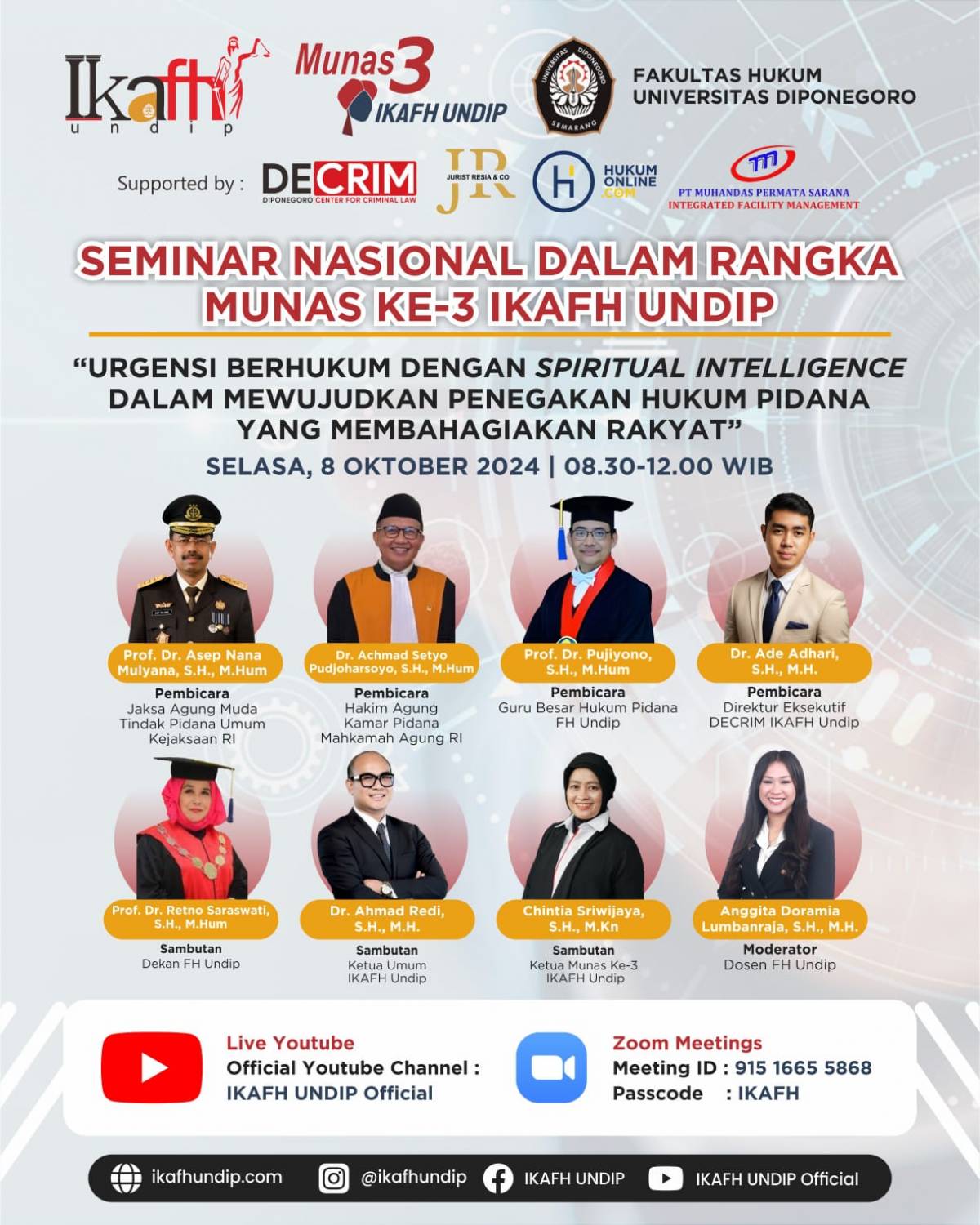
SEMINAR NASIONAL DALAM RANGKA MUNAS KE-3 IKAFH UNDIP

NONTON BARENG IKAFH UNDIP FILM PERJALANAN PEMBUKTIAN CINTA
Form Pernyataan Dukungan dan Form Pakta Integritas sebagai Syarat Calo ...
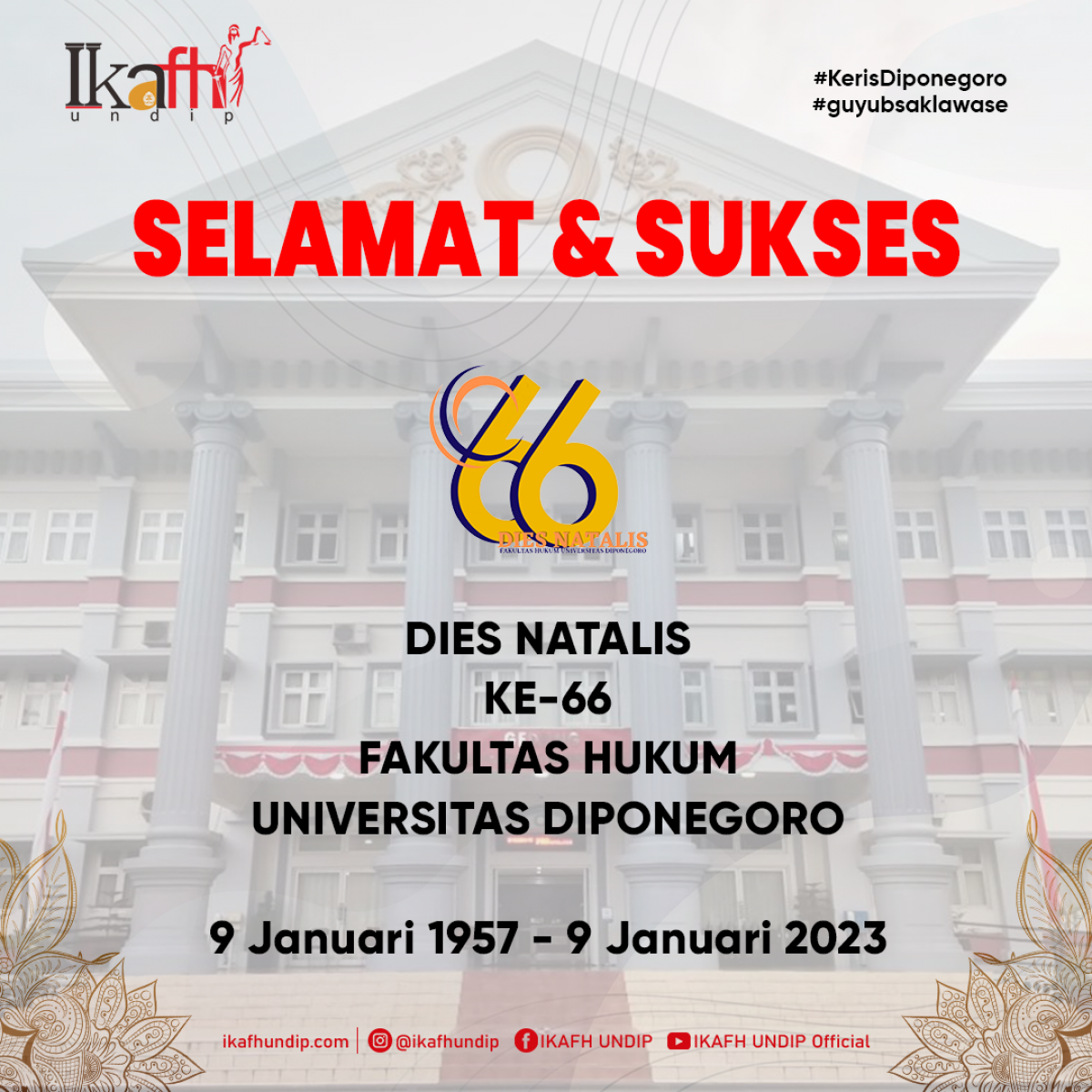
DIES NATALIS KE-66 FAKULTAS HUKUM UNIVERSITAS DIPONEGORO